
Senior American administration and diplomatic sources who sat in on the 50-minute mini-bilateral summit between President Barack Obama and Indian Prime Minister Dr Manmohan Singh, spoke animatedly how the "atmospherics were excellent," and what "a delight it was to watch the substantive interactions between these two extremely cerebral individuals".

Well briefed on India's angst over the ambiguity on the access to Lashkar operative and 26/11 conspirator David Coleman Headley and also the perceived US indifference to India's role in Afghanistan, US President Barack Obama has assured Prime Minister Manmohan Singh that he was "fully supportive" of India's request for access to Headley and "fully appreciated" and "recognized the enormous sacrifices" India has made in helping "stabilize" Afghanistan.

It's been full circle for Gautam Adhikari, erstwhile Washington bureau chief of the Times of India, who returns to the US capital and the think tank circuit as a visiting fellow at the East-West Center for a year-long residency co-sponsored by the Federation of Indian Chambers of Commerce and Industry, reports Aziz Haniffa.
United States President Obama will host Prime Minister Manmohan Singh in a mini bilateral summit before the start of the Nuclear Security Summit in Washington beginning April 12, instead of the brief meeting originally slated on the margins of the parley, claim sources. The report about the possible meeting comes amidst growing concern in both the US and New Delhi that the Obama administration has been ignoring India.
US President Barack Obama has appointed an Indian American, Srinija Srinivasan, to his 13-member Commission on Presidential Scholars.
The 'trust deficit' between the United States and Pakistan has seemingly evaporated after the strategic dialogue between Washington and Islamabad in March, that also featured Army chief General Ashfaq Kayani and Inter Services Intelligence director general Shujat Ahmad Pasha.If the remarks of Daniel Benjamin, the State Department's coordinator for counter-terrorism are anything to go by, the US no longer is suspicious of Pakistan playing a double game.
The US believes Lashkar-e-Tayiba, the Pakistan-based terrorist organisation, responsible for the horrific Mumbai terror attacks on 26/11 and several other terrorist acts in India, could soon replace Al Qaeda as the number one worldwide terrorist threat or at the very least compete with Osama bin Laden's global Terror Inc.
Ambassador Daniel Benjamin, coordinator for counter-terrorism at the United States department of state, has made it abundantly clear that his office will not influence law enforcement authorities via any diplomatic lobbying to provide India with direct access to Lashkar-e-Tayiba operative David Coleman Headley. Pakistani-American Headley was part of the conspiracy for the horrific terror attacks that shook Mumbai on November 26, 2008 and left 166 people dead.
US has said that it is yet to take a decision on Lashkar operative David Coleman Headley's extradition to India, said Robert Blake, the Obama Administration's point man for South Asia, especially India-Pakistan relations.
Assistant Secretary of State for South Asian Affairs Robert Blake said Pakistan had frequently raised the controversial and contentious water issue with India during his recent trip to Islamabad, but added that the US had no intention of intervening in the bilateral issue.

Nearly six months after he nominated Dr Islam A 'Isi' Siddiqui to be the chief agricultural negotiator at the office of the US Trade Representative, US President Barack Obama -- fed up with what the White House called 'obstructionist' policies by Senate Republicans in not confirming Siddiqui and several others -- appointed Siddiqui and 14 others as soon as the Senate adjourned for the Easter vacation-recess.
The report contains a significant Hindu American perspective, including the community's seva efforts across the country.

When President Barack Obama and Dr Manmohan Singh had announced the initiative, Geithner had said that 'India is an emerging global power and a country with which the US has an increasingly important economic and financial relationship.'

Sachin Pilot, Minister of State for Telecommunications and Information Technology, has predicted that, thanks to the mobile technology boom, telephone calls and related charges in India would soon be free. Pilot said that in such a scenario, telecom companies would have to think of novel ways to make money, with services such as data transfer to survive and stay competitive.

Pilot noted that 'the kind of damage that entities and groups and people can cause through the Internet and through the cyber-world is somehow disproportionate to their conventional capacities'.
Noting that the 123 Agreement between India and the US reflected deepening relationship between the two countries, top Obama Administration officials have said that it would have broader impact in the Indo-US ties.

India will be among the top five aviation markets in the world - both in terms of size and scale in the next five years, Civil Aviation Minister Praful Patel said.
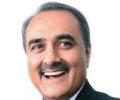
India's aviation sector would have a fully functioning satellite based navigation system (GPS) in place next year, Aviation Minister Praful Patel said.

Khanna, 42, the founder and medical director of the Khanna Institute of Lasik and Refractive Surgery in Beverly Hills, Los Angeles, and a practicing eye surgeon for over 15 years, has also been voted the Best Lasik Surgeon by consumers in Los Angeles.

Batra is the first Asian American attorney to receive this award.
